ERAS PHOTO REQUIREMENTS · SOURCE CHECK
Can You Smile With Teeth in an ERAS Headshot?
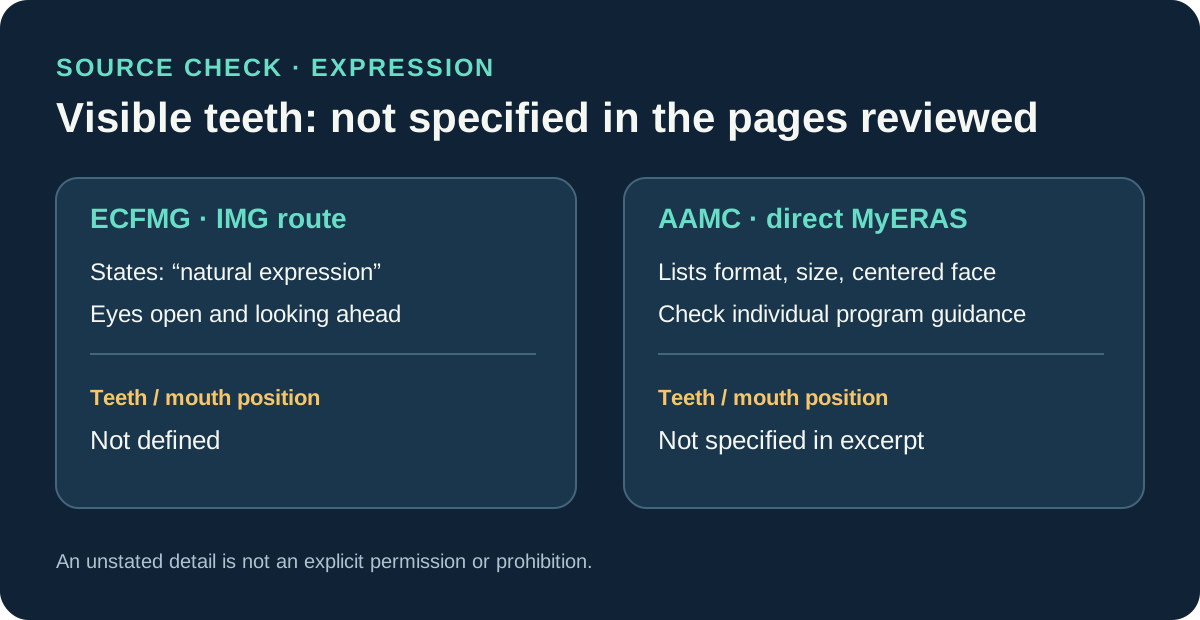
The current public AAMC and ECFMG photo instructions reviewed here do not say whether teeth should show. ECFMG asks for a “natural expression” with eyes open and looking directly ahead, but its page does not define that phrase by mouth position. The public wording reviewed therefore gives no teeth-specific yes or no.
What the public instructions actually cover
For IMG residency applicants using ECFMG's route, the current public photograph section lists a clear image, a full front view of the head and shoulders, a centered face, and a natural expression with eyes open and looking directly ahead. It also lists JPEG format, a 150 KB maximum, and dimensions no larger than 2.5 by 3.5 inches. The section does not define “natural” as a closed-mouth smile or a teeth-showing smile.
The AAMC's current public MyERAS photo page lists JPG/JPEG or PNG, a 150 KB maximum, and a centered face. It notes that programs use the image for identification and tells applicants to research programs individually for photo requirements and use. The public excerpt reviewed does not specify whether teeth should show. Direct page access presented a JavaScript/client challenge during this check, so this comparison is limited to the current indexed public excerpt and does not claim to cover an account-specific upload screen.
These two sources describe different applicant routes and should not be blended into one rule. ECFMG's phrase “natural expression” is a published criterion, but the wording reviewed does not explain a particular smile style. The absence of a teeth instruction is not proof that every expression is accepted, nor is it evidence of a ban.
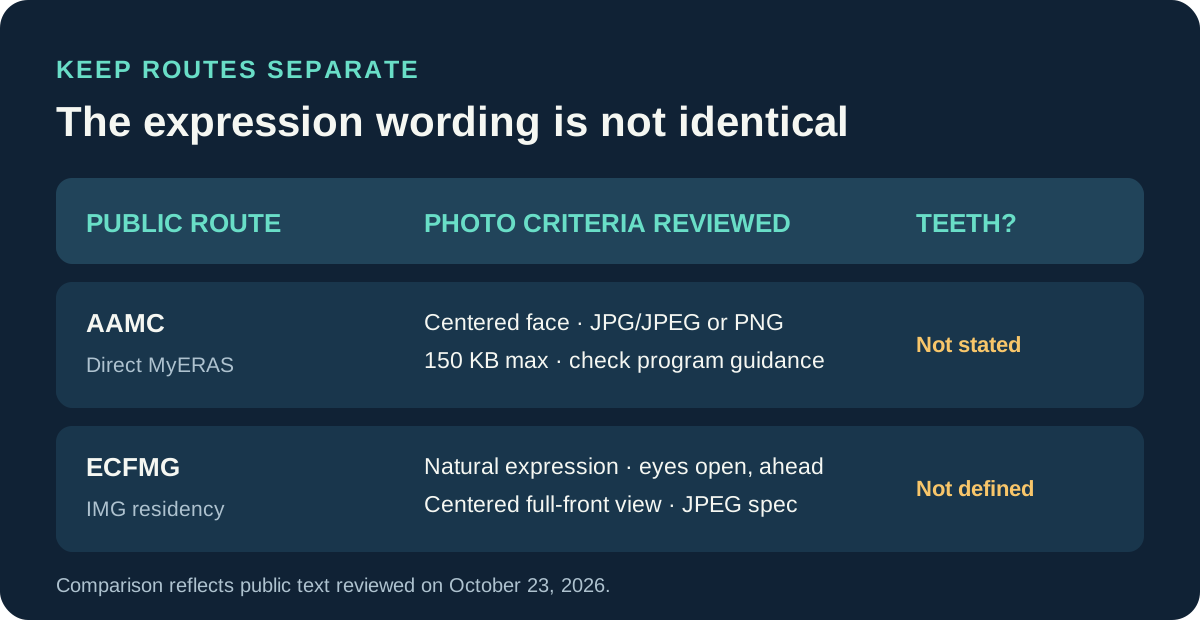
| Public source and route | Photo wording reviewed | Teeth visibility |
|---|---|---|
| AAMC direct MyERAS | JPG/JPEG or PNG, up to 150 KB, centered face; check individual program requirements and use. | Not specified in the public excerpt reviewed. |
| ECFMG MyIntealth for IMG residency applicants | Clear, full-front head-and-shoulders view; centered face; natural expression; eyes open and looking ahead; JPEG, up to 150 KB, no larger than 2.5 × 3.5 inches. | Not defined by mouth position in the photograph section reviewed. |
A source-by-source way to answer the question
The useful distinction is between a requirement the page states, a restriction it states, and a detail it leaves unstated. For this question, the reviewed ECFMG text states “natural expression” and open, forward-looking eyes; the AAMC excerpt states other image requirements and points applicants to program-specific information. Neither reviewed public text defines whether teeth should be visible. That is the limit of what this source comparison can establish.
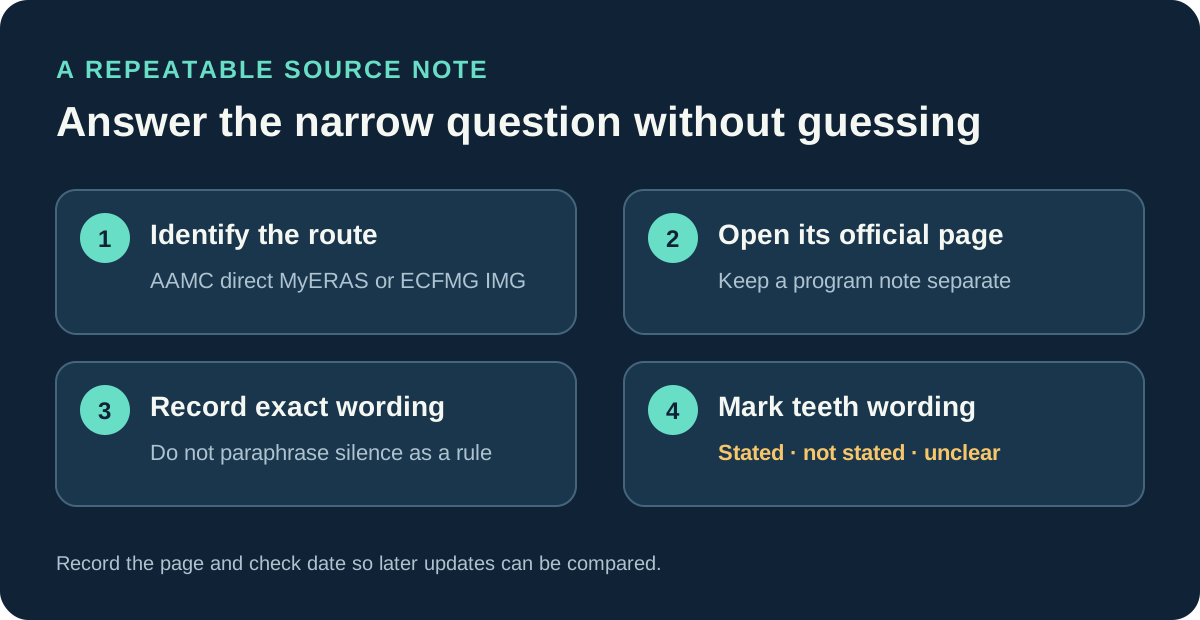
A repeatable source check keeps four fields together: (1) the applicant route, (2) the official page for that route, (3) the exact expression wording, and (4) whether the page mentions visible teeth. If the fourth field is blank, record “not stated in this section” rather than turning silence into an approval or prohibition. If an individual program publishes an additional photo instruction, record it separately with that program's name and date; do not attribute it to AAMC or ECFMG.
This method avoids a common category error: treating a visual preference, a central upload criterion, and a program-specific instruction as though they were the same kind of evidence. The central criteria reviewed can be quoted as criteria. A preference cannot be presented as a platform rule without a source. A statement not found in the reviewed page remains unknown unless a current source supplies it.
For this exact question, the comparison can be recorded in two rows instead of one blended summary. The AAMC row contains its public format, size, centering, and program-research wording; the teeth field remains “not specified in the excerpt reviewed.” The ECFMG row contains its composition and natural-expression wording; the teeth field remains “not defined in the photograph section reviewed.” The rows do not produce a shared yes/no result, because their published details are not identical and the AAMC page was only available through its indexed excerpt in this check.
If a new official page later answers the mouth-position question, the evidence note can be updated without rewriting the older source as though it always said that. Record the new source, route, wording, and date, then replace only the matching “not stated” field. If a public discussion repeats an answer without an official reference, keep it in the question-signal category; repetition does not turn a comment into a platform criterion. This makes the article’s conclusion traceable to the reviewed material and easy to revise when that material changes.
Why people ask about teeth
A public post in r/IMGreddit asks, “Can you smile with teeth for ERAS photo?” and connects the question to the phrase “natural expression.” The post is evidence that applicants are asking for clarification; it is not an official answer. Comments on a discussion thread should not replace the current instructions for the applicant's route or any separate program requirement.
Common questions
Does ECFMG require a closed-mouth smile?
The current public ECFMG photograph section reviewed does not say that. It asks for a natural expression with eyes open and looking directly ahead, but does not define mouth position.
Does AAMC say that teeth may show?
The public AAMC photo excerpt reviewed does not expressly answer whether teeth should show. It lists file type, size, face centering, route responsibility, and program-specific research.
Does “not specified” mean any smile will pass?
No. It means the public section reviewed did not provide a teeth-specific rule. It does not predict a portal validation result or every program's instructions.
What should an applicant record if they find another instruction?
Keep the route, source, exact wording, and date together. Treat a program's statement as program-specific and keep it distinct from the central AAMC or ECFMG public page.
Sources and scope
- AAMC, “Photo,” MyERAS applicant guidance — current indexed public excerpt reviewed for photo format, size, centering, route, and program-specific research. The page itself presented a client challenge in this check.
- ECFMG/Intealth, “ERAS: Supporting Documents,” Photograph section — current public wording for composition, expression, file format, size, and dimensions.
- r/IMGreddit, “Can you smile with teeth for ERAS photo?” — a public question signal, not an official requirement.
Public wording checked October 23, 2026. This page does not test either applicant portal or make a claim about individual program preferences. Residency Headshot is independent and is not affiliated with AAMC, ECFMG, Intealth, ERAS, or the National Resident Matching Program.
Watch the ERAS headshot smile-expression explainer
This companion video summarizes the AAMC and ECFMG wording discussed above. English captions are burned into the video frames.
Watch the ERAS headshot smile-expression explainer on YouTube