ERAS PHOTO REQUIREMENTS · SOURCE CHECK
Can You Wear Glasses in an ERAS Headshot?
The current AAMC and ECFMG photo instructions reviewed here do not expressly say whether glasses are allowed or prohibited. Their published checklists focus on other image and file criteria, so that silence is not a yes or a no.
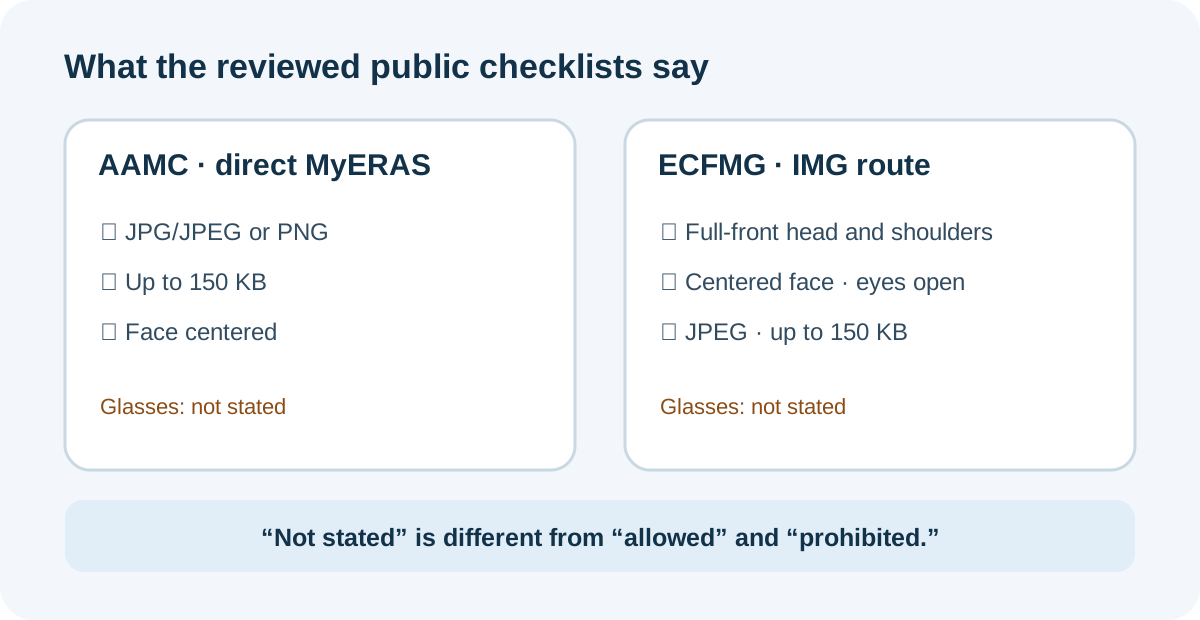
What the current official pages say
The AAMC’s current MyERAS photo page tells applicants to use JPG/JPEG or PNG, keep the file at or below 150 KB, and center the face. It also says applicants should research individual programs for their photo requirements and use. Glasses do not appear in that published list.
For IMG residency applicants, ECFMG’s current ERAS Supporting Documents page describes a clear, full-front head-and-shoulders photo, a centered face, a natural expression, open eyes looking ahead, JPEG format, a maximum file size of 150 KB, and dimensions no larger than 2.5 by 3.5 inches. Its published photograph section does not mention glasses either.
Those statements answer a narrower question than “Are glasses allowed?” They show what these two public checklists specify. They do not establish an unlisted rule, and they do not prove how every program will use or prefer a photo. For a glasses-specific policy, the material reviewed here leaves the answer unstated.
| Applicant route | What the public checklist lists | Does that checklist mention glasses? |
|---|---|---|
| AAMC direct MyERAS | JPG/JPEG or PNG, maximum 150 KB, centered face; check individual program requirements and use. | No mention in the listed criteria reviewed. |
| ECFMG MyIntealth for IMG residency applicants | Clear full-front head-and-shoulders view; centered face; natural expression; eyes open and looking ahead; JPEG; maximum 150 KB; no larger than 2.5 × 3.5 inches. | No mention in the photograph section reviewed. |
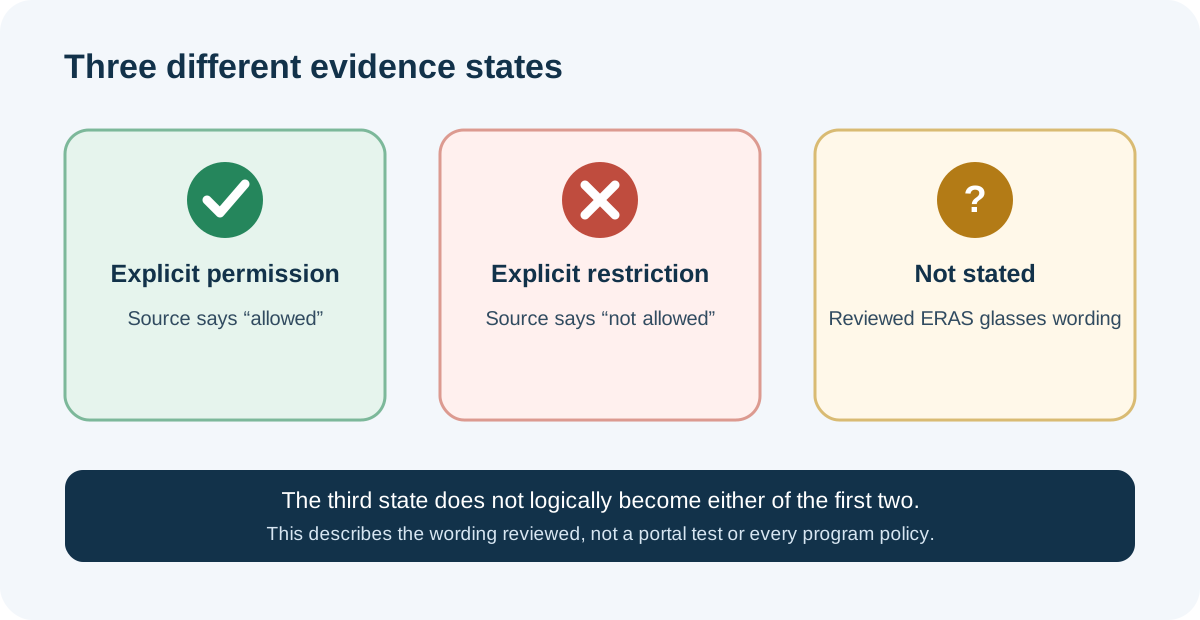
How to read an unstated requirement without guessing
A recurring source of confusion is the jump from “I cannot find glasses in the checklist” to “glasses are definitely allowed” or “glasses are banned.” Neither conclusion follows from the text alone. This is a source-reading distinction: an explicit permission, an explicit restriction, and no statement are three different evidence states.
To make that distinction practical, this page compares the two route-specific official photograph sections item by item. The comparison has three outcomes: a criterion stated by the source, a glasses rule stated by the source, or no glasses rule stated in the section reviewed. Both sources provide photo criteria; neither of the two sections reviewed supplies the glasses-specific outcome. That result describes the pages, not a private portal validation test or a universal program policy.
The separate AAMC instruction to research programs individually matters because it marks where the central checklist stops. It does not say that programs have a glasses restriction; it says to verify individual requirements and use. The ECFMG page likewise identifies its IMG route and upload process. Treating those route descriptions as one combined list can make an applicant mistake an omitted detail for a universal standard.
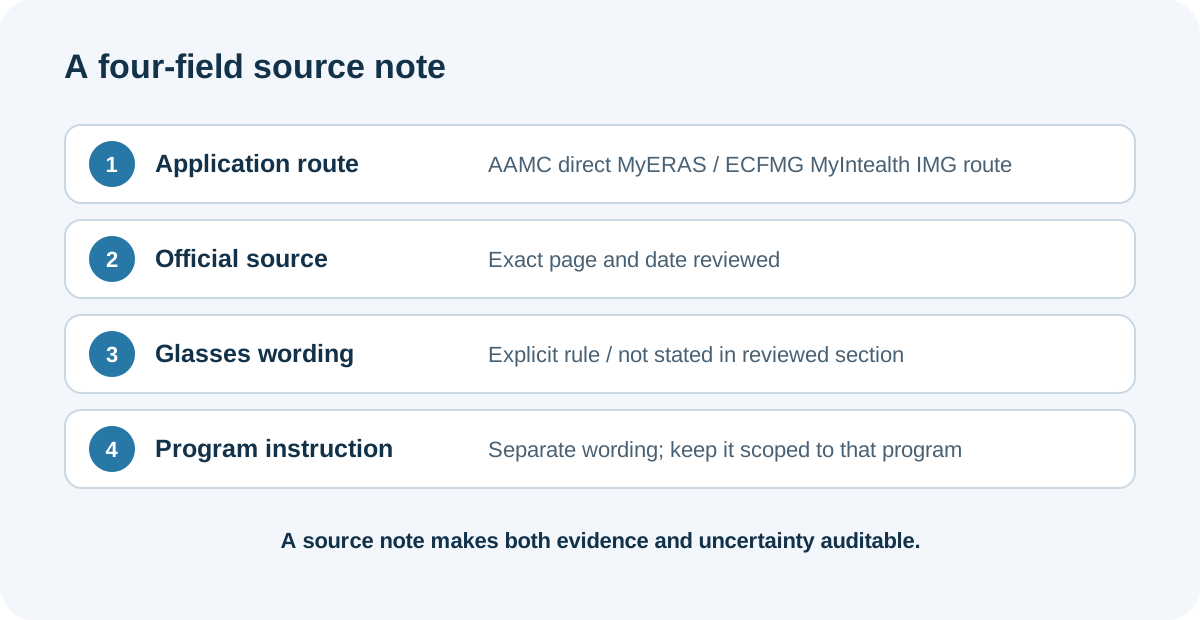
A useful evidence note can therefore be written in four fields: the route, the exact official page, the glasses wording found (or “not stated in the reviewed section”), and any separate program instruction. This format preserves what is known and leaves unknowns visible. It also makes a later update easy: if the official page changes, only the relevant source row needs to be checked again.
Keep three questions separate
- What does the central route checklist state? Compare the photo with the criteria published for the actual application route. The AAMC and ECFMG lists are not interchangeable.
- Does the source explicitly address glasses? In the sections reviewed for this article, neither does. Record that as “not stated,” rather than converting it into permission or prohibition.
- Is there a program-specific instruction? The AAMC page says to research programs individually. A separate program page or written instruction is its own source and should not be presented as a universal AAMC or ECFMG rule.
This is a source-check workflow, not a claim that a particular pair of glasses will pass an upload or suit every program. It separates a technical checklist from an unstated styling question and from a program’s own instruction. The public sources reviewed cannot answer beyond those boundaries.
Common questions
Does AAMC say glasses are allowed in an ERAS photo?
The current AAMC photo checklist reviewed does not expressly say that glasses are allowed or prohibited. It lists other photo criteria and directs applicants to research individual programs.
Does ECFMG prohibit glasses for IMG applicants?
The ECFMG photograph section reviewed does not state a glasses prohibition. It lists composition and file requirements for its IMG route. An unstated rule should not be reported as a ban.
Do the official instructions prove that glasses will be accepted?
No. The reviewed checklists do not supply a glasses-specific acceptance statement. They also do not let this article predict every program’s use of a photograph.
What if a program publishes its own photo instruction?
Keep that instruction attached to that program and route. The AAMC asks applicants to research programs individually; a program-specific statement should not be generalized to every ERAS applicant.
Sources and scope
- AAMC, “Photo,” MyERAS applicant guidance — current direct-MyERAS criteria and instruction to research programs individually.
- ECFMG, “ERAS: Supporting Documents,” Photograph section — current IMG-route composition, technical criteria, and MyIntealth submission information.
- r/IMGreddit, “Eras photo” — a public applicant discussion includes the direct question “Glasses allowed?”; it is a question signal, not an official rule.
Official photo guidance checked October 21, 2026. This article compares public instructions and does not test either applicant portal. Residency Headshot is independent and is not affiliated with AAMC, ECFMG, Intealth, ERAS, or the National Resident Matching Program.
Watch the glasses guidance explainer
This companion video summarizes the public AAMC and ECFMG wording shown above. It distinguishes an explicit rule from a detail the reviewed pages leave unstated; it does not predict every program’s policy. English captions are burned into the video.