ERAS HEADSHOT / SELF-TAKEN PHOTOS
Can I take my own ERAS headshot?
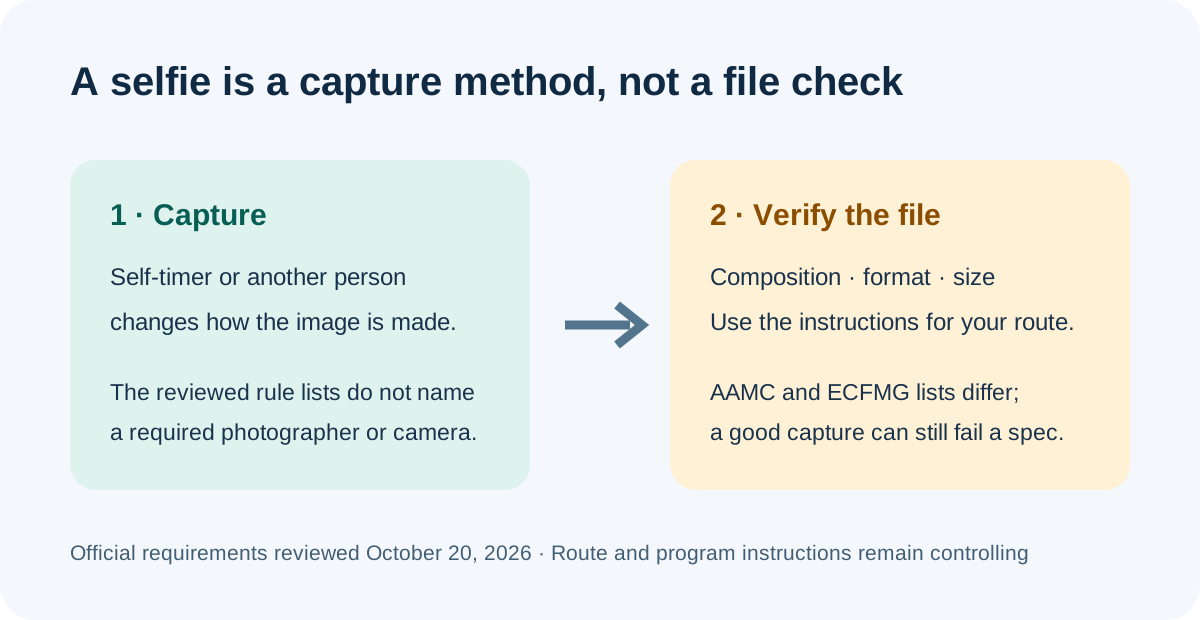
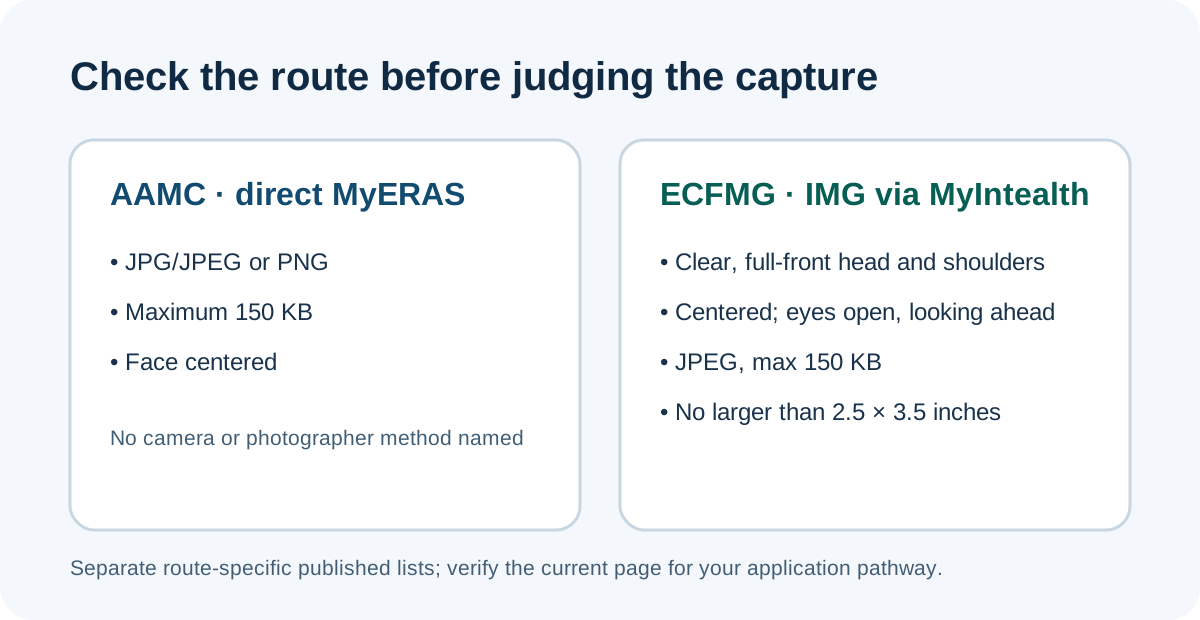
The AAMC photo requirements reviewed do not name a required photographer or camera method. For direct MyERAS, the published list checks JPG/JPEG or PNG, a maximum 150 KB, and a centered face. For IMG applicants using ECFMG’s MyIntealth route, ECFMG also specifies a clear full-front head-and-shoulders view, centered face, natural expression, eyes open and looking ahead, JPEG, a maximum 150 KB, and maximum dimensions of 2.5 × 3.5 inches. A self-taken image still has to meet the rules for the applicant’s route.
What the official photo pages actually check
The AAMC’s current MyERAS photo page tells applicants to select an image that meets its listed requirements. It names the file types, 150 KB limit, and centered face. It does not say that an applicant must hire a photographer, use a rear camera, or avoid a phone-taken photo. The page also says applicants should research programs individually to verify each program’s requirements and use of the photo.
ECFMG’s instructions are for IMG residency applicants submitting through MyIntealth. That page gives a more specific composition description: a clear full-front view of the head and shoulders; face centered; natural expression; eyes open and looking directly ahead. Its technical list says JPEG, no more than 150 KB, and no larger than 2.5 by 3.5 inches. It does not state who must operate the camera.
| Route in the official page | Listed checks | Does the page specify the capture method? |
|---|---|---|
| AAMC direct MyERAS | JPG/JPEG or PNG; maximum 150 KB; face centered. | No photographer or camera method is named in the listed photo criteria. |
| ECFMG MyIntealth for IMG residency applicants | Clear full-front head-and-shoulders photo; centered face; natural expression; eyes open and looking ahead; JPEG; maximum 150 KB; no larger than 2.5 × 3.5 inches. | No person or camera method is named in the photo instructions. |
Separate the camera question from the file question
“Can I take it myself?” can mean two different things. The first is about capture: whether a professional photographer, another person, a tripod, or a self-timer has to make the image. The reviewed AAMC and ECFMG pages do not prescribe an operator. That is a narrow statement about what those public pages say; it is not a promise that every residency program has identical preferences.
The second question is about the result: whether the actual exported image meets the specifications for the correct application route. A photo can be professionally made and still need a format, size, framing, or route check. Conversely, an image made with a phone timer is not automatically compliant merely because a camera captured it. The submission file—not only a camera preview or an editing-app canvas—is the object to compare with the instructions.
One useful way to keep the questions from getting mixed together is to write two separate answers on your review note: “Capture method: self-timer / another person / photographer” and “Route checks: passed / not checked.” Only the second answer can be compared directly with the published technical criteria. If a program asks for something beyond the central AAMC or ECFMG page, record that as a program-specific requirement rather than treating it as a universal rule.
This distinction also keeps forum advice in its proper place. Public discussions include both applicants asking whether people usually take their own picture and replies asserting that selfies should never be used. Those replies show that the issue causes uncertainty; they do not amend AAMC’s or ECFMG’s published requirements.
A five-check review for a self-taken photo
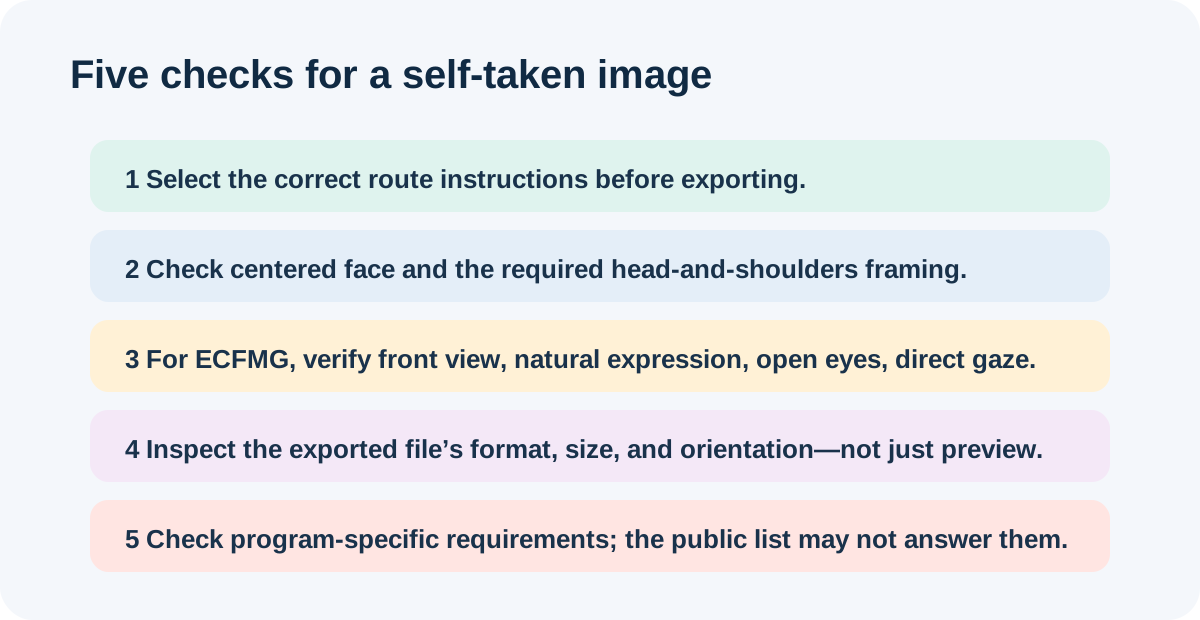
- Choose the route first. Identify whether your public instructions are the AAMC direct-MyERAS page or ECFMG’s MyIntealth instructions for IMG residency applicants. Do not borrow a dimension or format from the other route.
- Review the saved image, not only the live camera preview. Open the file you intend to submit. The AAMC list asks for a centered face; the ECFMG page additionally spells out a full-front head-and-shoulders view.
- Apply the composition wording that belongs to your route. On the ECFMG route, check the stated natural expression, open eyes, and direct gaze. If using the AAMC list, do not invent extra universal composition requirements that its photo list does not state.
- Check the exported file against the technical list. Confirm the format and file size. On the ECFMG route, also verify the stated maximum physical dimensions. A crop preview is not a substitute for checking the saved export.
- Look for a program-specific rule. The AAMC page explicitly directs applicants to research programs individually. If a program’s own instructions create a separate question, follow that source or ask that program; do not rely on an anonymous comment as policy.
This checklist is an editorial workflow built from the published route requirements: select the source, inspect the image, apply only that source’s composition checks, verify the exported file, and then check program-specific instructions. It answers whether self-capture is expressly named in the reviewed public rules without claiming that a camera method alone guarantees acceptance.
Common questions
Does AAMC say a photographer has to take the photo?
The AAMC photo page reviewed lists image requirements but does not name a required photographer or camera method. It also advises applicants to check individual programs for their requirements and use of the photo.
Does ECFMG require a professional studio photo?
The ECFMG IMG photograph instructions reviewed describe the image and file criteria; they do not identify a professional studio or photographer as a technical requirement. Check the current page and any instructions that apply to your program.
Does a selfie automatically pass because the camera method is not listed?
No. The absence of a named camera method does not waive the listed framing, format, size, or route-specific checks, and it does not establish every program’s preferences. Review the exact file and the applicable instructions.
Watch the short explainer
Open the video on YouTube. English captions are burned into the video itself.
Sources and scope
- AAMC, “Photo,” 2027 MyERAS Applicant User Guide — direct-MyERAS photo criteria and direction to research program requirements.
- ECFMG, “ERAS: Supporting Documents — Photograph” — IMG-route composition, file, and dimension instructions.
- r/IMGreddit, “ERAS PICTURE: DOs and Don’ts” — public question about taking a photo oneself; comments are treated as a question signal, not official policy.
Official pages checked October 20, 2026. This article does not claim to test applicant portals or establish the requirements of every program. Residency Headshot is independent and is not affiliated with AAMC, ECFMG, Intealth, ERAS, or the National Resident Matching Program.