ERAS HEADSHOT / OFFICIAL PURPOSE
What is an ERAS headshot used for?
The AAMC says programs most often use the photo to help identify you when you report for an interview. ECFMG’s instructions for IMG residency applicants also call it a memory aid when programs create a rank order list. Those statements describe identification and recall; they do not specify a photo score, selection weight, or a universal screening rule.
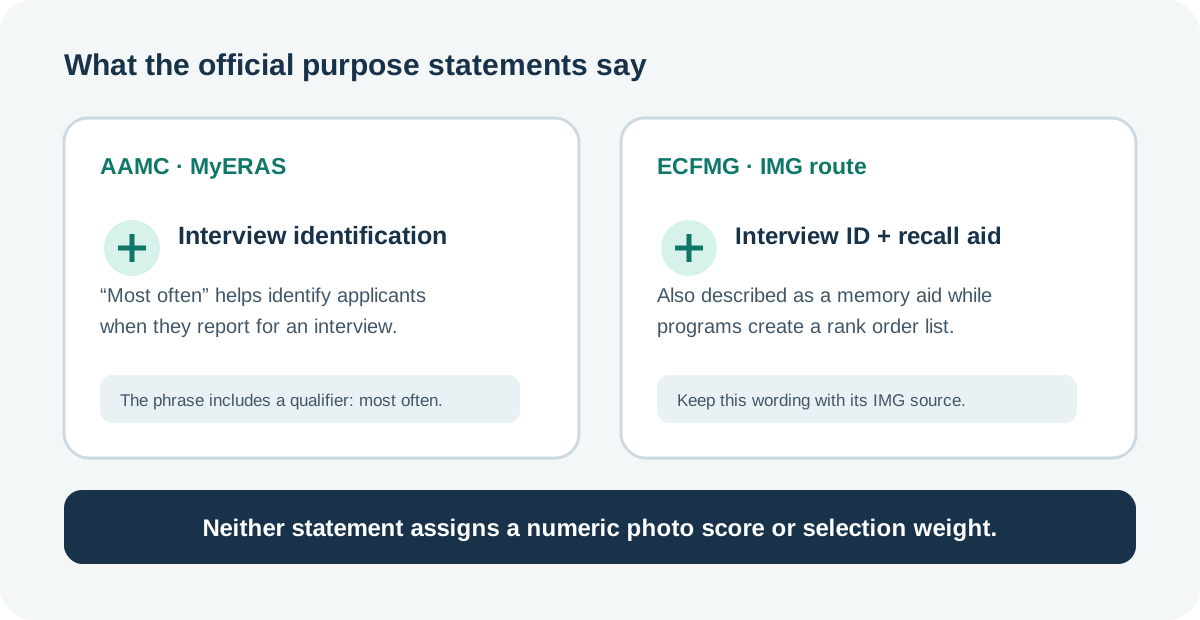
What the current official pages say
The AAMC’s MyERAS Photo page says the photo is “most often” used by programs to help identify applicants when they report for an interview. “Most often” describes a common purpose; it does not say the only purpose or the point in the application review when every program opens the photo.
ECFMG’s supporting-document instructions use more detail for IMG residency applicants: programs use the photograph to identify the applicant at an interview and as a memory aid when creating a rank order list. This is wording on the ECFMG route’s page. Keep it attached to that source and route rather than silently extending it into a claim about every MyERAS workflow.
| Public source | Route context | Purpose explicitly stated |
|---|---|---|
| AAMC, Photo | MyERAS applicant instructions; ECFMG handles IMG residency photo uploads | Most often, helping programs identify applicants when they report for an interview. |
| ECFMG, ERAS Supporting Documents — Photograph | IMG residency photo through MyIntealth | Interview identification and a memory aid when programs create a rank order list. |
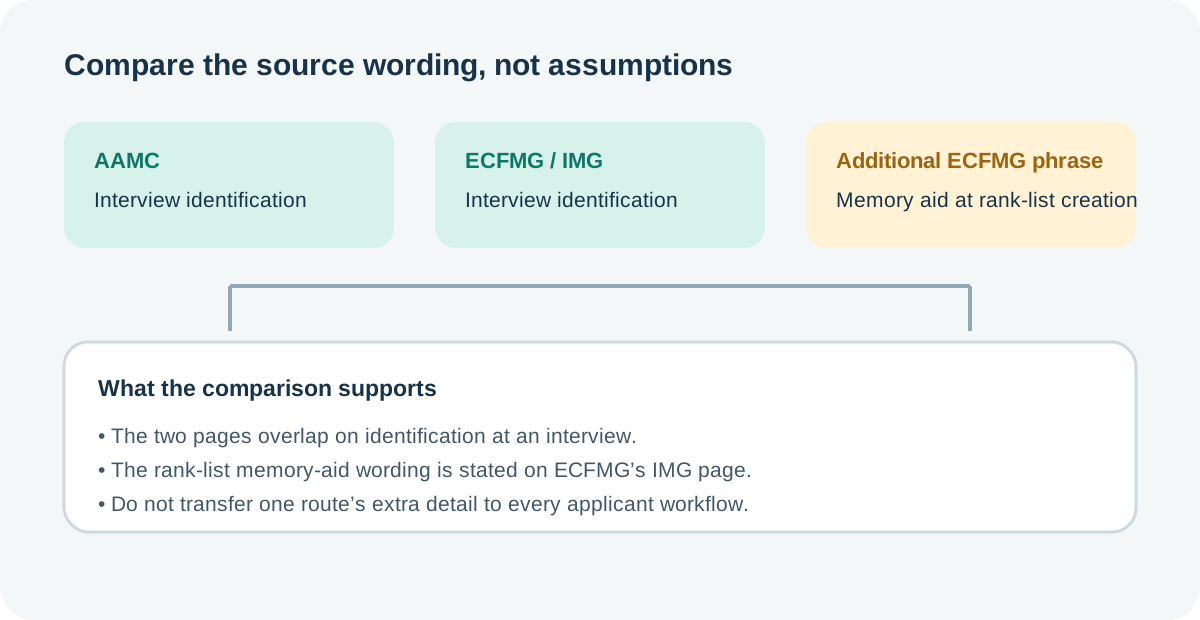
What this wording does not tell you
A stated purpose is not a complete description of how every program configures its review process. The AAMC sentence does not specify whether a program sees a picture before an interview invitation, whether it is hidden during screening, or how much it affects a decision. ECFMG’s “memory aid” wording does not assign the photo a score or say that it changes an applicant’s rank. The pages reviewed do not provide a common, measurable weight for the photograph.
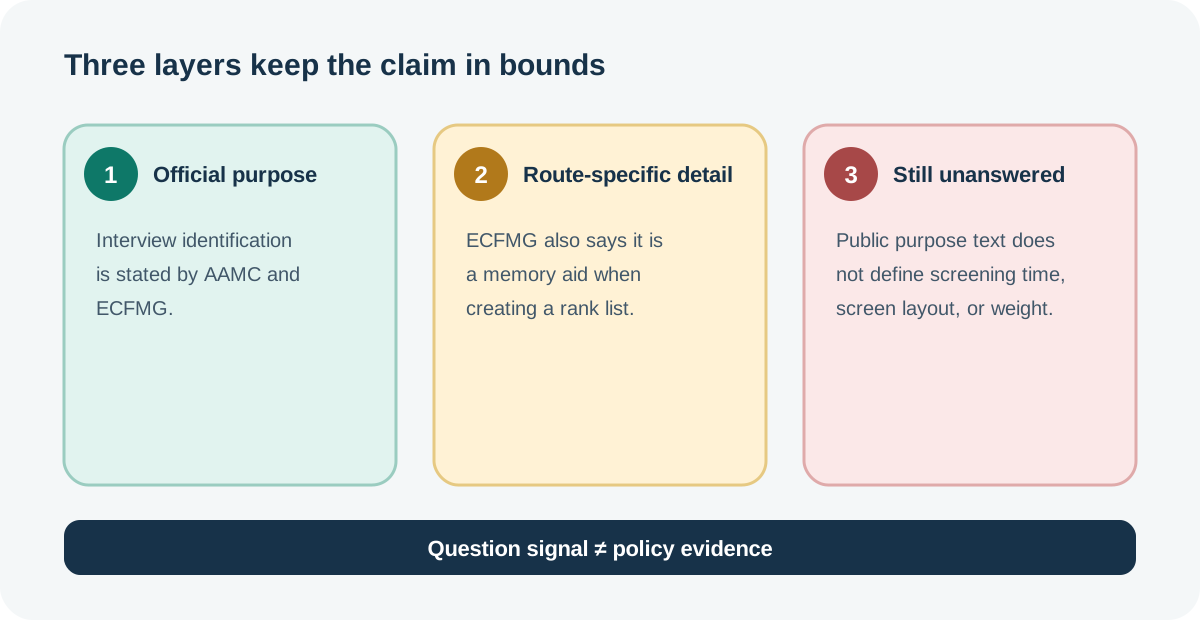
That boundary matters because applicants ask whether programs “care” about the photo or see it at a particular stage. A September 2024 applicant discussion asked whether program directors really care about ERAS photos and included conflicting personal opinions. A September 2026 thread asked whether programs see a circle crop or the separately opened image. Those posts establish that applicants have the questions; they cannot settle program policy or describe every current interface.
Read the available statements in three layers: first, the task named by the official source (interview identification); second, the additional IMG-route phrase (memory aid during rank-list creation); third, the unknowns that the wording leaves open (review timing, interface, and decision weight). Do not turn the third layer into a claim just because a forum reply sounds certain.
A source-first way to answer “what does my photo do?”
- Identify the photo route. AAMC’s direct MyERAS guidance and ECFMG’s IMG supporting-document guidance are not interchangeable pages.
- Quote the purpose in its own scope. For AAMC, record “most often” and “when you report for an interview.” For ECFMG, record both interview identification and the memory-aid wording.
- Separate purpose from evaluation. Neither sentence states a numeric score, a selection formula, or the photo’s weight relative to other application materials.
- Check a program-specific question with that program. If the question is about whether a particular program displays a photo during screening or uses it in a particular way, the public applicant guidance does not answer it; ask the program directly rather than treating anonymous replies as policy.
This four-part reading method is an editorial synthesis of two current official pages and the questions applicants publicly ask. It preserves the source’s qualifier and route while preventing an unstated review-stage or ranking claim from being presented as fact.
Common questions
Does an ERAS headshot determine whether I get an interview?
The AAMC’s statement describes interview identification as the photo’s most common use. It does not say that the photo determines who receives an interview. The reviewed public wording does not quantify the photo’s effect on selection.
Does the photo affect my rank order list?
ECFMG says programs use the IMG-route photograph as a memory aid when creating a rank order list. That is not the same as saying the image is scored or changes rank; the page does not state a ranking weight.
Can I know exactly when a program sees the image?
Not from these public purpose statements. They do not document every program’s review timing or screen layout. Ask the specific program about its workflow if that is the question you need answered.
Watch the photo-purpose walkthrough
This short companion keeps the AAMC wording, the ECFMG IMG-specific addition, and unanswered questions separate.
Sources and scope
- AAMC, “Photo,” 2027 MyERAS Applicant User Guide — purpose wording for applicant photographs; also directs applicants to check individual program requirements.
- ECFMG, “ERAS: Supporting Documents — Photograph” — purpose wording and photo requirements for IMG residency applicants using MyIntealth.
- r/medicalschool, “ERAS PHOTOS” (September 11, 2024) — an applicant asks whether program directors care about the photo; discussion is treated as a question signal, not policy.
- r/medicalschool, “ERAS Headshot” (September 3, 2026) — an applicant asks whether programs see a circle preview or a separately opened photo; replies are not treated as authoritative.
Sources checked October 19, 2026. This page compares public wording; no applicant portal or program review system was accessed. It does not claim that a headshot changes selection outcomes. Residency Headshot is independent and not affiliated with AAMC, ECFMG, Intealth, ERAS, or the National Resident Matching Program.