ERAS PHOTO REQUIREMENTS · SOURCE CHECK
Can You Edit or Retouch an ERAS Headshot?
The public AAMC photo instructions reviewed here do not define a retouching policy. ECFMG’s current photo section lists composition and file requirements, while a separate general notice warns against submitting falsified or altered documents without defining how that notice applies to ordinary portrait retouching. Those pages do not establish a universal yes or no for every kind of photo edit.
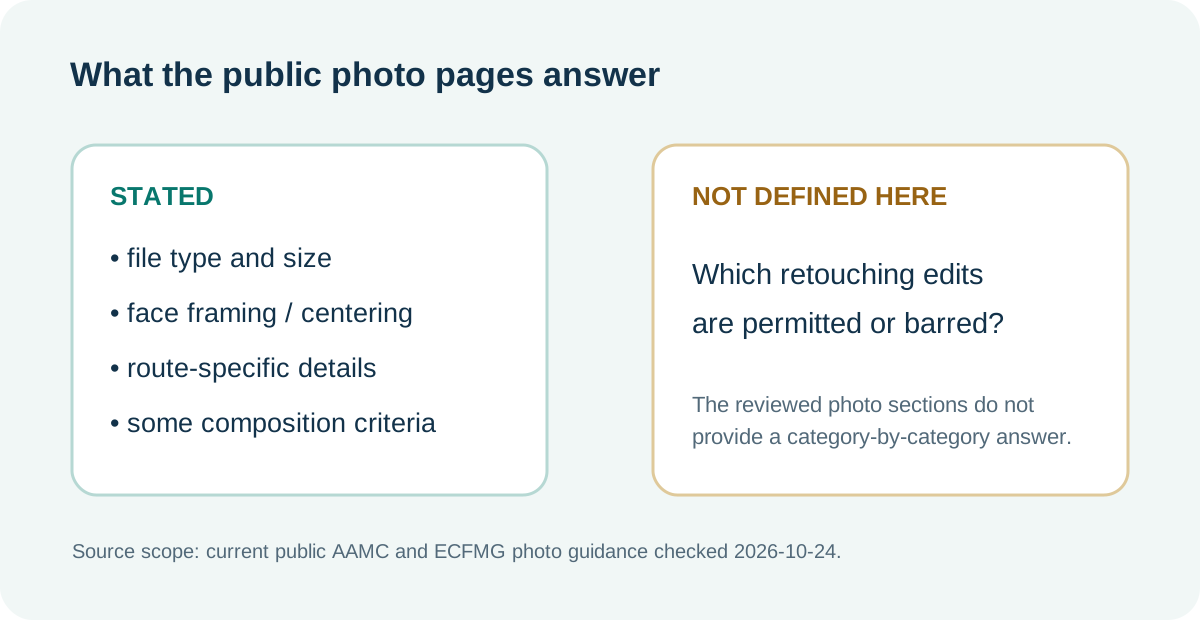
What the photo pages actually specify
The AAMC’s MyERAS photo page says a U.S. medical school graduate uploads a JPG/JPEG or PNG file no larger than 150 KB, with the face centered. It also says programs use the photo most often to help identify applicants at interviews and tells applicants to research program requirements and use individually. In the public photo instructions reviewed, AAMC does not describe retouching, skin smoothing, background replacement, or other editing categories.
For the ECFMG route, the current ERAS Supporting Documents page asks for a clear, full-front view of the head and shoulders, a centered face, and a natural expression with eyes open and looking directly ahead. Its technical section specifies JPEG, a maximum file size of 150 KB, and no larger than 2.5 by 3.5 inches. The photo section does not enumerate allowed or disallowed portrait edits.
These are route-specific public pages. A detail omitted from one section cannot be filled in by borrowing a sentence from the other route. Likewise, meeting a format or centering check does not answer whether an image change is acceptable under every account-specific or program-specific instruction.
| Source and route | Photo wording located | Retouching detail |
|---|---|---|
| AAMC MyERAS photo guidance | JPG/JPEG or PNG; maximum 150 KB; centered face; programs use the photo for identification and applicants should check program requirements. | No retouching categories in the public photo wording reviewed. |
| ECFMG MyIntealth photo guidance | Clear, front-facing head-and-shoulders view; centered face; natural expression; eyes open and looking ahead; JPEG, 150 KB maximum, up to 2.5 × 3.5 inches. | No photo-specific list of permitted or prohibited edits in the photograph section reviewed. |
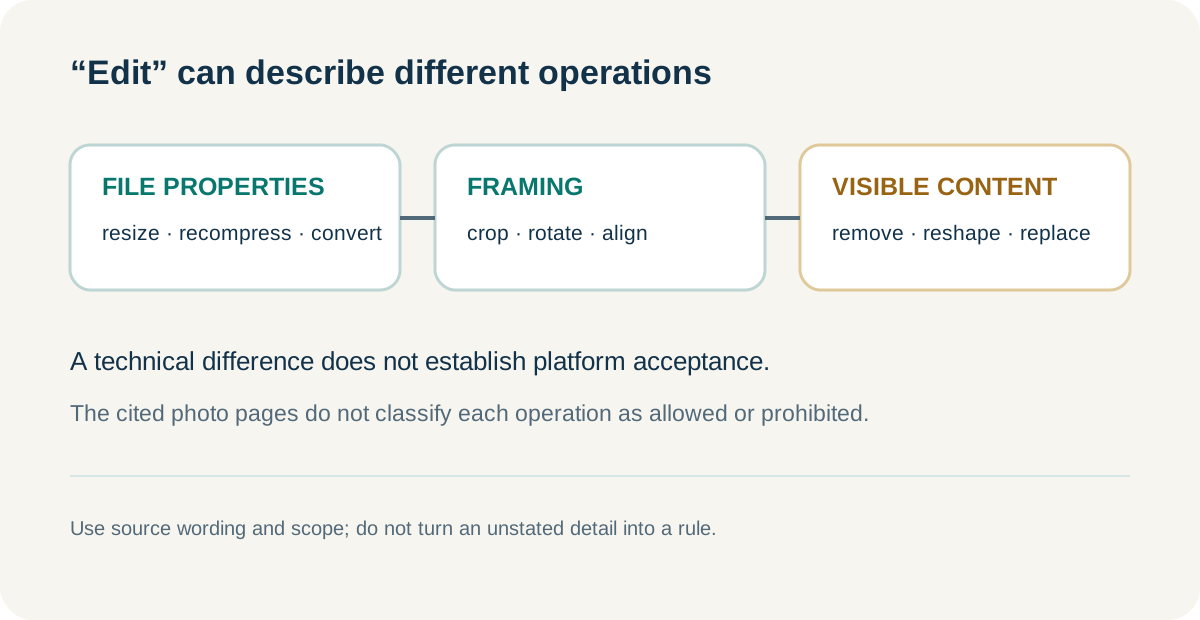
How to read the separate altered-document notice
ECFMG’s page includes a broader notice in its document-submission material: submission of a falsified or altered document to ECFMG is an example of irregular behavior. The page discusses supporting documents generally and does not define, in the photograph subsection, which portrait adjustments count as an “altered document.” It would overstate the source to turn that broad notice into a detailed rule about every retouching operation; it would also overstate the photo subsection to treat its silence as blanket permission.
A useful source audit records both the statement and its scope. First, mark where the sentence appears: in a general submission/policy notice or in the photo-specific requirements. Next, copy the exact category named by the page—here, “falsified or altered document”—without replacing it with a narrower phrase such as “digital retouching is forbidden.” Finally, note whether the same page defines the category for photographs. In the current text reviewed, that photo-specific definition is not supplied.
This separation matters because common production steps are not interchangeable. Resizing changes dimensions; recompression changes encoding and file bytes; color-profile conversion changes how color values are interpreted; cropping changes the frame; removing an object or reshaping facial features changes visible content. The public photo specifications identify some file properties and visible framing criteria, but they do not map each operation to a retouching rule. This list is a technical distinction, not a claim that any listed operation is accepted by the application.
For a traceable review, make a two-column change log before and after export: “file/format operation” and “visible scene or identity change.” Record the source file, exported file, and which public requirement each check addresses. A successful file-size or format check establishes only that measured property. It does not establish a platform decision about the image’s contents.
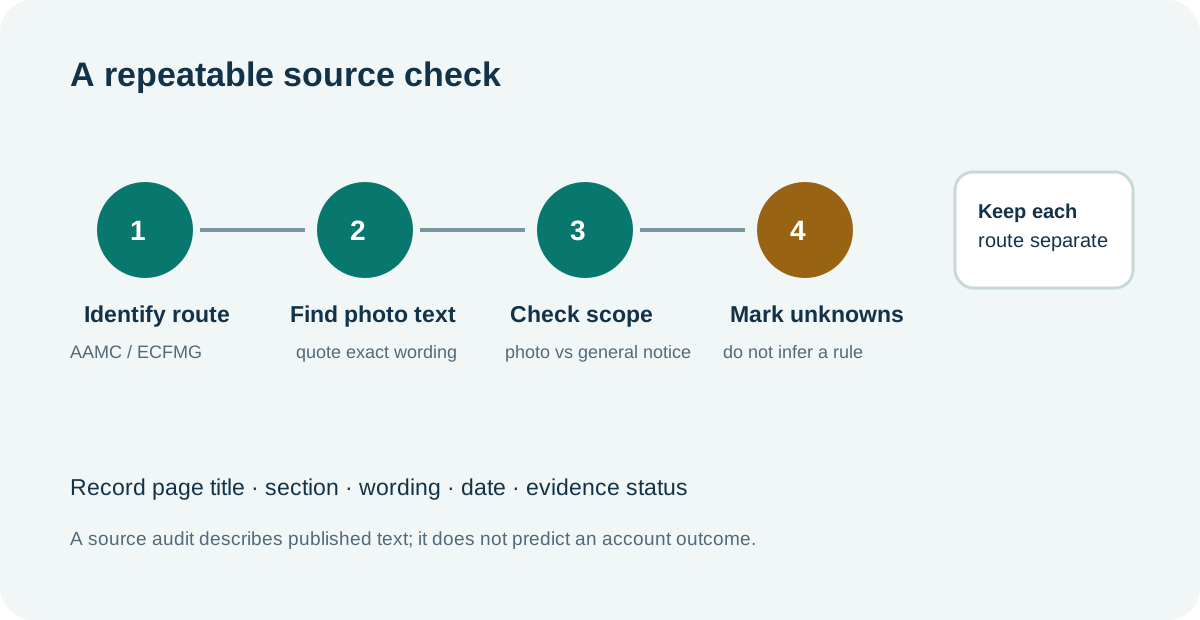
Use the same source note when instructions change: capture the page title, relevant section, exact wording, access date, and route. If a portal or program supplies a separate instruction, keep it as a separate record rather than attributing it to the AAMC or ECFMG public page. If a page is inaccessible or an account screen is needed, label that evidence unavailable instead of inferring what it says.
Why the question comes up
Applicants discuss whether to change a photo’s background or make other edits, but a forum question is a signal of uncertainty, not an official rule. This article uses the discussion only to identify the question being asked; the conclusion above comes from the published AAMC and ECFMG pages linked below.
Common questions
Does AAMC explicitly allow retouching?
The public AAMC photo instructions reviewed specify file type, maximum size, and a centered face. They do not expressly describe retouching in that section.
Does ECFMG’s altered-document notice specifically define photo retouching?
The general notice mentions falsified or altered documents, but the photograph subsection reviewed does not define that phrase for portrait edits. The cited wording therefore does not answer every edit scenario.
Is file compression the same as changing how a person looks?
No. Compression changes encoded file data; changes to visible features alter image content. The public pages reviewed do not classify every technical or visual operation under a specific retouching rule.
Does passing a file checker mean the photo is approved?
No. A file checker can report measurable properties such as format, dimensions, or size. It cannot determine a program’s decision or supply an unstated policy interpretation.
Sources and scope
- AAMC, “Photo,” MyERAS applicant guidance — public photo requirements and program-specific-use wording.
- ECFMG, “ERAS: Supporting Documents” — photograph requirements and separate general altered-document notice.
- Applicant discussion about editing an ERAS photo background — question signal only, not policy evidence.
Checked 2026-10-24. This comparison describes the cited public wording; it does not predict a portal outcome or replace route-specific instructions.
Watch the ERAS headshot photo-editing explainer
This companion video summarizes the AAMC and ECFMG wording discussed above. English captions are burned into the video frames.