ERAS PHOTO · FACE FRAMING · SOURCE CHECK
Does an ERAS headshot have to show both ears?
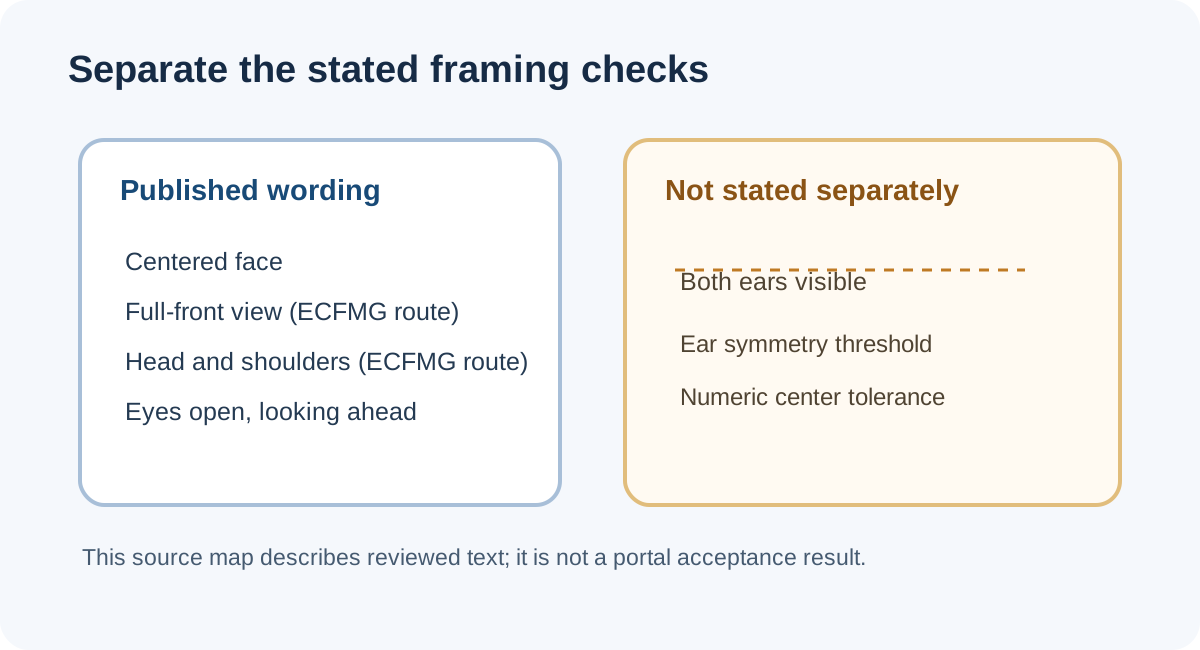
The public photo instructions reviewed here do not list visible ears as a separate requirement. AAMC’s MyERAS page says the face should be centered; ECFMG’s IMG instructions specify a clear, full-front view of the head and shoulders with the face centered and eyes open, looking ahead. Those are the stated checks. They do not define a one-ear-visible pass/fail rule or an allowed amount of face offset.
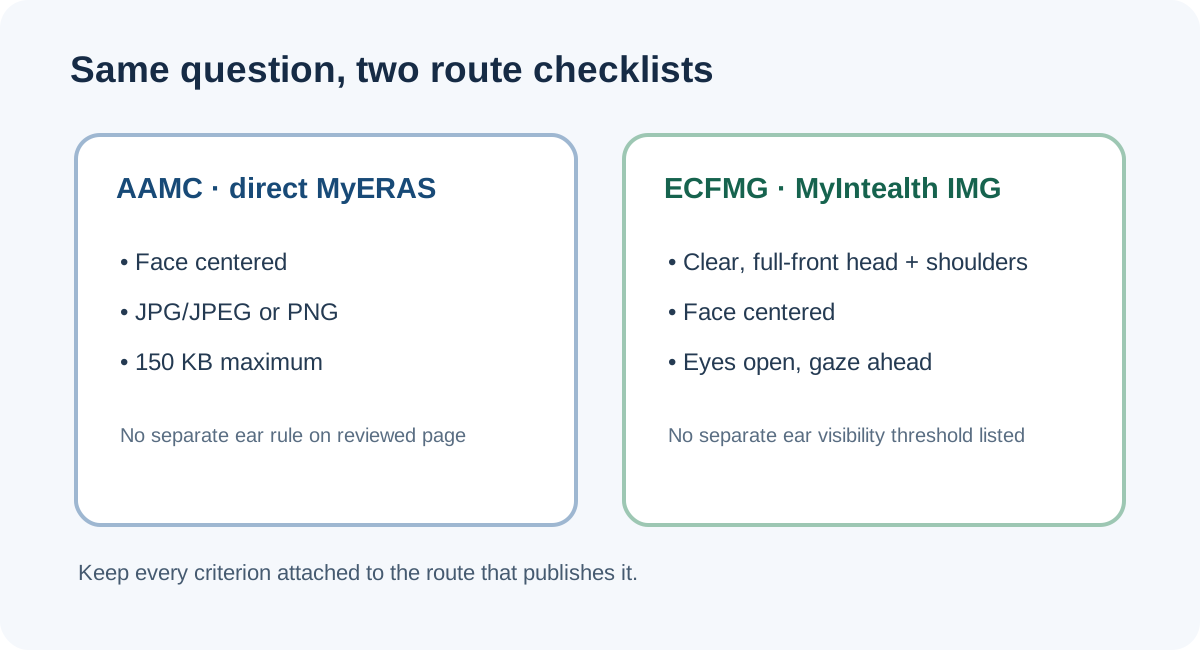
What each public source actually checks
The question often combines two observations: the face looks off-center, and one ear is not visible. The official wording reviewed does not make these the same test. AAMC lists a centered face in its direct MyERAS photo criteria. ECFMG’s IMG route adds a clear, full-front head-and-shoulders view, a centered face, a natural expression, open eyes, and a forward gaze. Neither page names “both ears visible” as a standalone condition.
| Route/source | Published framing words | What the wording does not specify |
|---|---|---|
| AAMC direct MyERAS | Face is centered in the photo. | It does not give an ear-visibility rule or numeric centering tolerance on the reviewed page. |
| ECFMG MyIntealth for IMG residency photos | Clear, full-front head-and-shoulders view; centered face; natural expression; eyes open and looking ahead. | It does not separately require both ears to be visible or quantify how much face offset is allowed. |
This is a comparison of published text, not a measurement of a private portal’s image validator. AAMC and ECFMG describe different submission routes, so the ECFMG wording should not be silently added to AAMC’s shorter checklist.
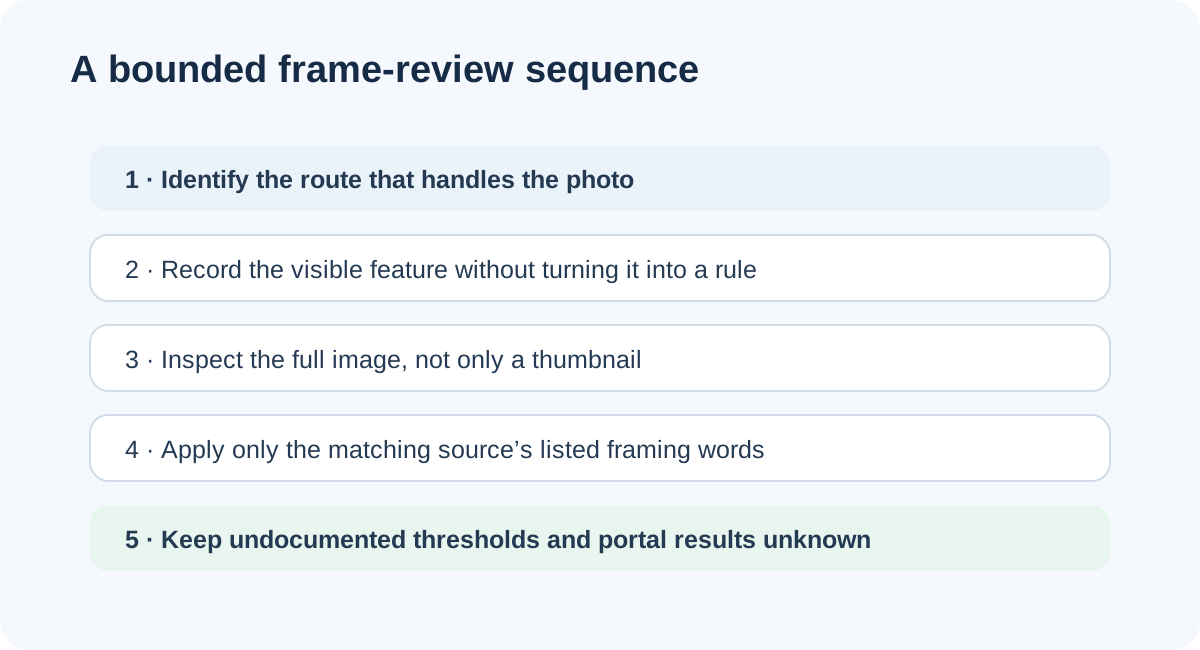
A bounded check for a frame with one ear hidden
Use this as a record of visible properties, not as a portal-acceptance test. First identify the route that will handle the file. Then assess only the words published for that route. For AAMC direct MyERAS, record whether the face appears centered and check the route’s file type and size requirements separately. For an IMG photo submitted through MyIntealth, also record whether the view is clear, full-front, head-and-shoulders, and shows eyes open with a forward gaze.
- Describe the observation neutrally. Write “left ear not visible” or “face appears left of the frame center.” Do not convert that observation into an undocumented rejection reason.
- Check face placement on the full image. Review the actual image file rather than a circular or thumbnail preview alone. A separate guide covers what a preview does and does not establish.
- Apply the route’s exact framing language. A one-ear-hidden observation may be relevant to reviewing a front-facing composition, but it does not by itself prove that the published checklist has failed.
- Keep unknowns explicit. The public instructions reviewed do not give a numerical centering tolerance, an ear-visibility threshold, or a private-screen preview guarantee.
- Use account-specific support for a portal message. If the portal flags the file, record the exact message and route. Do not infer that a forum reply or a diagram on this page reveals the account’s validation result.
The steps above are an independent reading workflow built from the official criteria and their limits. They deliberately do not recommend changing a photo solely to expose an ear, and they do not predict whether a particular file will be accepted.
Common questions
If one ear is hidden, does that automatically fail the ERAS photo check?
The reviewed AAMC and ECFMG public criteria do not name one-ear visibility as a separate automatic failure condition. They do give route-specific framing language, including a centered face and, for the ECFMG IMG route, a full-front head-and-shoulders view. The portal’s result for an individual file is not established by these public pages.
Does “face centered” mean both ears must be equally visible?
The reviewed pages do not define “centered” through ear symmetry or provide a numeric tolerance. Record face placement and ear visibility as separate observations instead of treating one as a substitute for the other.
Does ECFMG say “full front”?
Yes. The ECFMG photograph section uses “full front view” for the head and shoulders, with the face centered, eyes open, and gaze ahead. That wording applies to its MyIntealth IMG submission route.
Does the AAMC MyERAS checklist give the same full-front wording?
The AAMC public Photo page reviewed lists file type, maximum file size, and a centered face for direct MyERAS uploads. Keep its page’s stated list separate from ECFMG’s longer framing description.
Where did the one-ear question come from?
A public applicant post asked whether an off-center face with one ear not shown was acceptable. That post is a signal about the question applicants ask; it is not evidence of AAMC policy or an individual upload outcome.
Sources and scope
- AAMC, Photo — current public direct-MyERAS photo criteria and instruction to check programs individually. The page returned a client challenge during this review; its indexed public text was checked, and no undisplayed wording is inferred.
- ECFMG/Intealth, ERAS: Supporting Documents — Photograph — MyIntealth IMG route, full-front/head-and-shoulders wording, centered face, expression, eyes, upload, transfer, and assignment statements.
- r/IMGreddit, “Eras photo” — applicant question about a slightly off-center face and one ear not shown. Used only as a question signal, not as policy or a current account outcome.
Sources checked November 13, 2026. No applicant photo, account, or upload was examined. This page does not claim that ear visibility predicts selection or guarantees acceptance. Residency Headshot is independent and not affiliated with AAMC, ECFMG, Intealth, ERAS, or any residency program.
Video explainer
This source-based explainer compares AAMC and ECFMG framing language without claiming that ear visibility is a separate portal threshold. The English narration is AI-generated; English captions are included.