FILE LAB / ERAS HEADSHOT
Can an ERAS headshot be PNG?
Yes for the AAMC direct MyERAS photo route; ECFMG’s MyIntealth route specifies JPEG. The AAMC Photo chapter lists JPG/JPEG or PNG. ECFMG lists JPEG. Both pages state a 150 KB maximum. The upload route matters before the filename does.
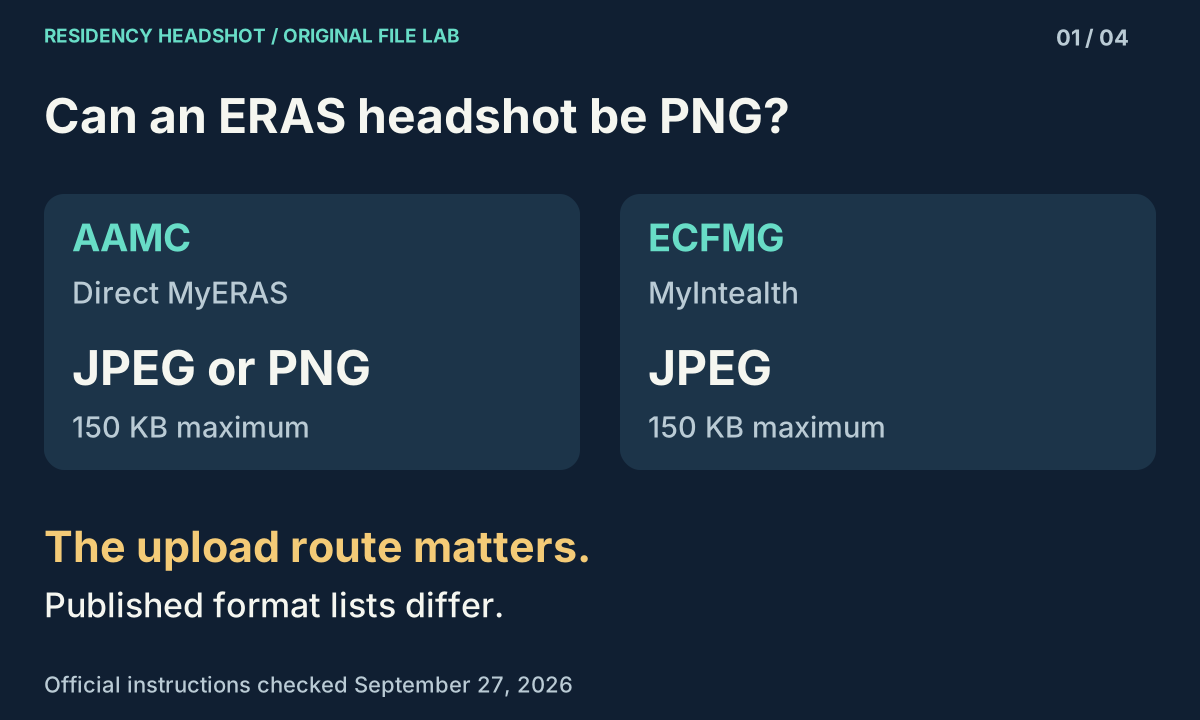
Two upload routes, different format lists
| Official instructions | Format list | Maximum file size |
|---|---|---|
| AAMC Photo chapter: direct MyERAS upload | JPG/JPEG or PNG | 150 KB |
| ECFMG Photograph: MyIntealth upload | JPEG | 150 KB |
AAMC describes direct MyERAS photo upload for U.S. medical graduates and directs international medical graduates to ECFMG’s instructions. ECFMG’s current photograph section names MyIntealth as its upload service and also limits the image to 2.5 by 3.5 inches.
This table compares file formats, not every photograph requirement. AAMC’s separate residency documents overview also lists dimensions and resolution. A format appearing in the table does not establish that a particular photograph meets all the applicable conditions.
Our experiment: a new extension versus a new encoding
We made one synthetic card containing a gradient, small text, narrow lines and solid color blocks. It contains no person. We deliberately kept its dimensions at 600 by 840 pixels across every file so the comparison would isolate renaming from conversion. Those dimensions are a laboratory input, not a proposed ERAS export preset.
First, we saved the card as an RGB PNG using Pillow 12.3.0, with compression level 6. Second, we copied its exact bytes into a file whose name ends in .jpg. Third, we separately opened the original PNG and encoded a real JPEG with quality setting 90, chroma subsampling 0 and optimization disabled. No cropping or resizing occurred.
We then measured each file’s byte count, first eight bytes, decoder-reported format and decoded RGB pixels. We compared SHA-256 hashes of both the complete files and the decoded RGB data. That separates a changed name from changed encoded contents, and changed encoded contents from changed image pixels.
| File | Decoded format | Bytes | Pixels | RGB versus source |
|---|---|---|---|---|
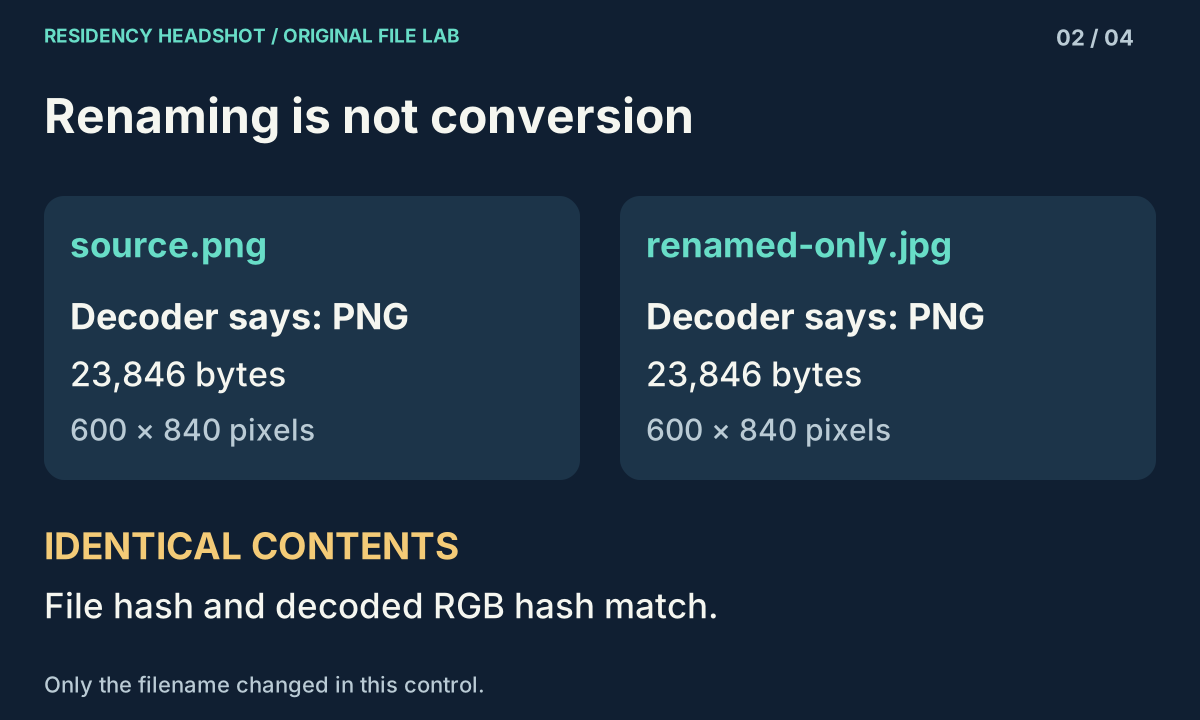
| source.png | PNG | 23,846 | 600 × 840 | Identical |
| renamed-only.jpg | PNG | 23,846 | 600 × 840 | Identical |
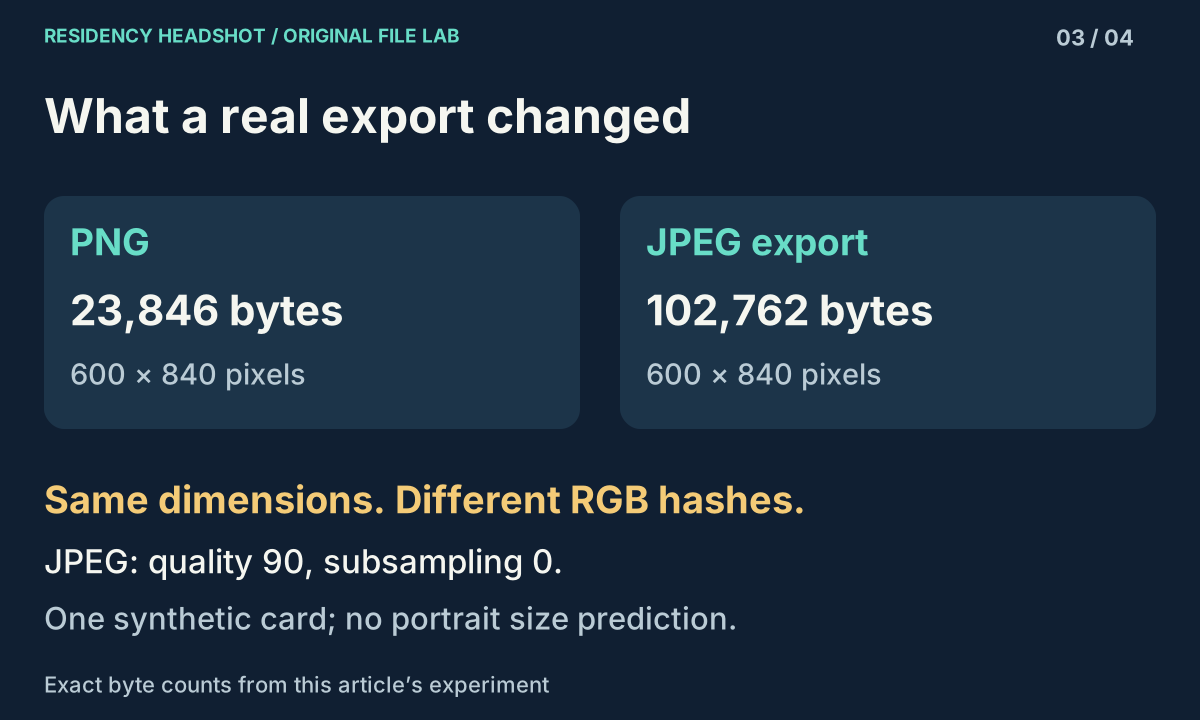
| converted-quality90.jpg | JPEG | 102,762 | 600 × 840 | Different |
The renamed copy still decoded as PNG. Its complete file hash matched the source, as did its decoded-pixel hash. Its first eight bytes were the PNG signature, 89 50 4e 47 0d 0a 1a 0a. The .jpg ending changed none of those properties. The exported JPEG instead began ff d8 ff e0 00 10 4a 46 and the decoder identified it as JPEG.
Download the three test files, measurements and reproduction script · View the raw measurements
Conversion changed the contents, not the pixel dimensions
Our original PNG and renamed copy each contained 23,846 bytes. The actual JPEG export contained 102,762 bytes. In this particular test, converting to JPEG produced a larger file. The result rules out a universal promise that this format change always makes a file smaller. It does not establish what would happen to a camera portrait or with different export settings.
All three decoded images remained 600 by 840 pixels. However, the JPEG’s decoded RGB hash differed from the source’s hash. Preserving width and height did not preserve the exact pixel values through this export. We did not score visible portrait quality, facial detail or suitability for an application.
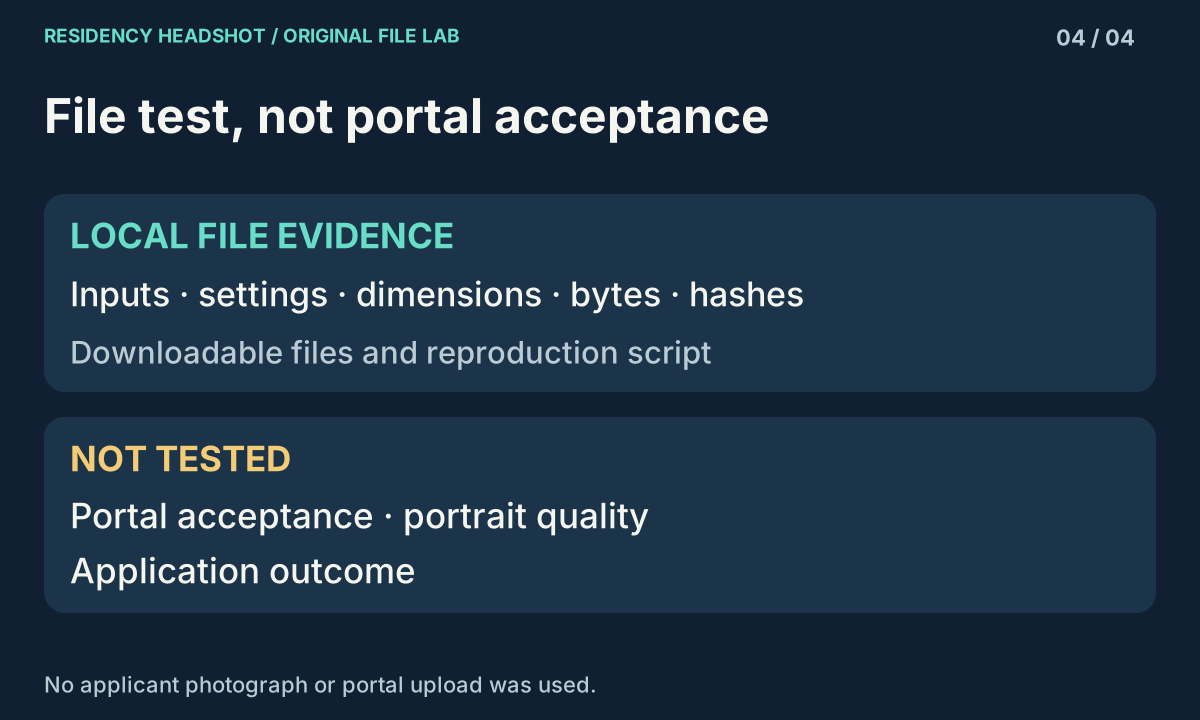
The byte results are deliberately reported as exact integers instead of rounded KB labels. The official pages above use KB; this experiment did not determine how either upload system implements that limit. A local file measurement and a successful portal submission are different observations, and this test supplies only the former.
What the downloadable evidence contains
The archive pairs each observation with an input. The source.png file is the generated card; renamed-only.jpg contains the same bytes under a different extension; converted-quality90.jpg is the separate JPEG encoding. The misleading extension exists only as a diagnostic control. None of these cards is an applicant photograph or a portal submission sample.
The measurements file records the Python and Pillow versions, encoder settings, exact byte counts, dimensions, detected formats and both kinds of SHA-256 hash. The included reproduction script generates a new set in a test-output folder, or in an explicitly supplied output directory. Matching the recorded library version helps make an encoding comparison meaningful; a different encoder build can produce different compressed bytes.
Three distinct checks explain the result. Identical file hashes show that the source and renamed control have identical contents despite different names. Matching decoded RGB hashes show that they also yield identical pixels. The converted file has a different signature, a different format reported by the decoder and different decoded RGB data. No portal behavior needs to be assumed to establish any of these local observations.
Watch the illustrated explanation
This video follows the article’s four original diagrams and explains the file-format comparison in English. Captions are burned into the video.
Questions about PNG and JPEG
Are JPG and JPEG different image formats?
No. They are common filename extensions for the same format. Mozilla’s image-format guide lists both extensions for JPEG.
Does renaming a PNG to .jpg convert it?
No. Our renamed test file retained the source’s PNG signature, bytes and decoded pixels. An actual encoding operation produced the JPEG in the comparison.
Does a PNG appearing in AAMC’s list mean ECFMG accepts it?
No. These are separate published format lists. ECFMG’s photograph instructions specify JPEG for its MyIntealth route.
Did this experiment test the ERAS upload system?
No. It tested local file contents. We did not upload the card to MyERAS or MyIntealth, test their filename validation or inspect their internal image processing.
Related tools and sources
The photo checker and file preparation tool are available separately. The DPI metadata experiment examines a different question: changing density fields while preserving encoded image data.
- AAMC: Photo and Documents for ERAS Residency Applicants
- ECFMG: Supporting Documents, Photograph section
- Mozilla: Image file type and format guide
- Our original measurements
Official sources checked September 27, 2026. The experiment, figures and downloadable card were made for this article. This site is independent of AAMC and ECFMG.