ERAS HEADSHOT · CLOTHING RULES
Does ERAS require a suit, tie, or white coat in your headshot?
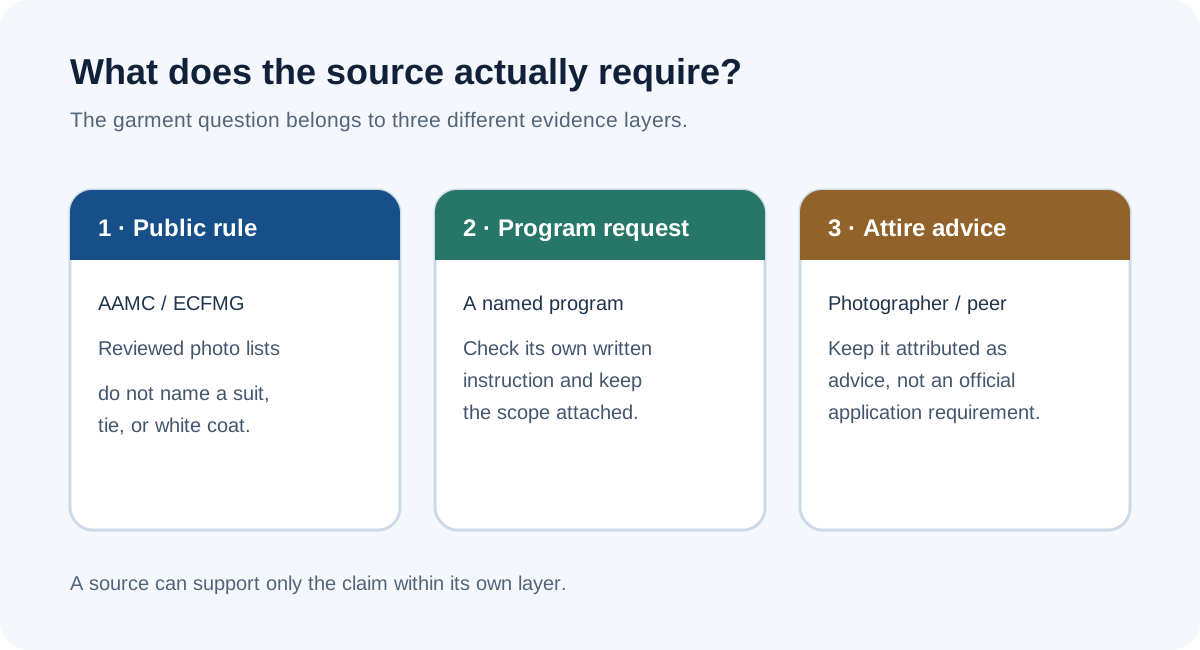
The public AAMC and ECFMG ERAS photo instructions reviewed here do not specify a suit, tie, or white coat. AAMC tells applicants to check programs individually for photo requirements and use. That leaves program-specific requests and personal attire choices as separate questions; it does not establish that any particular outfit is accepted everywhere or affects selection.
What the official photo pages say
The AAMC Photo chapter for direct MyERAS lists accepted file types, a 150 KB maximum, and a centered face. It says the photo is most often used to help programs identify applicants at interviews and tells applicants to research programs individually for their requirements and use of the photo. Its reviewed public photo checklist does not name a suit, tie, or white coat.
ECFMG’s ERAS Supporting Documents photo instructions for the MyIntealth route specify a clear, front-facing head-and-shoulders view, centered face, natural expression, open eyes looking ahead, and technical file limits. The reviewed photograph section does not name a required garment either.
This is a bounded reading of these two public photo pages, not a claim that every account screen or every program lacks additional instructions. Keep the upload route and any explicit program request in view; a photographer’s style guidance or a forum reply is not an AAMC or ECFMG requirement by itself.
A three-layer source matrix for attire claims
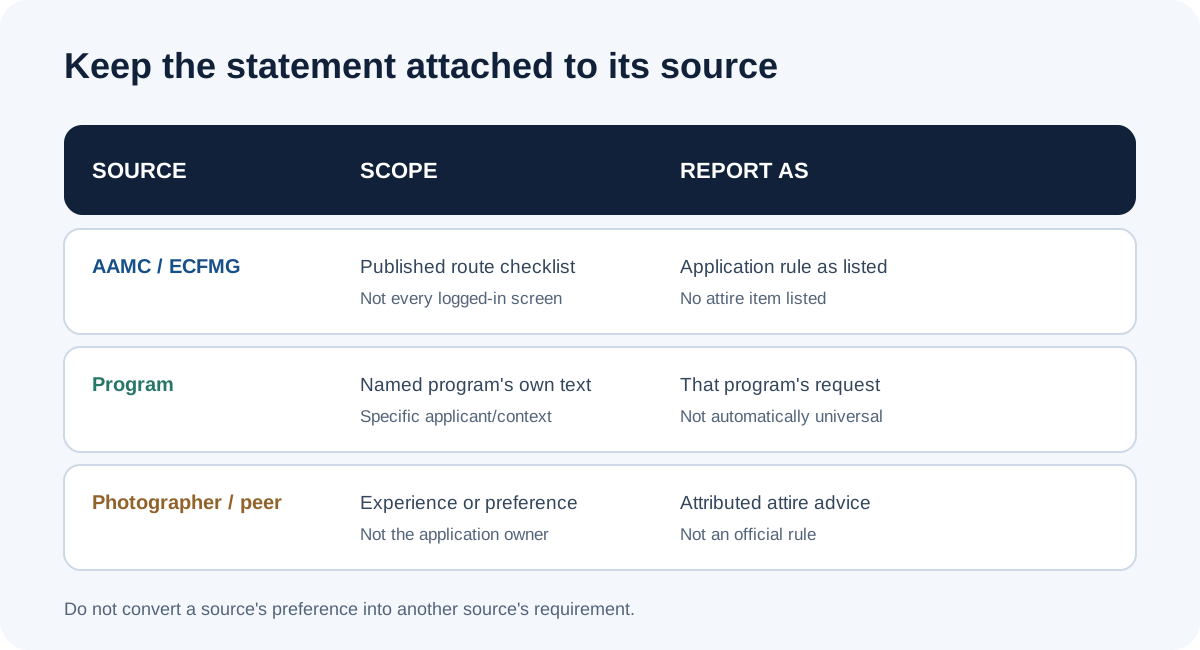
| Statement layer | What belongs in it | How to report it | What it cannot establish alone |
|---|---|---|---|
| Published application rule | Exact requirements on the AAMC or ECFMG page for the applicant’s route. | Name the page and quote or accurately summarize its listed item. | Unlisted clothing rules, private-screen checks, or a selection effect. |
| Program-specific instruction | A request issued by the specific program or shown in its application material. | Identify which program and where the request appears. | A universal instruction for other programs. |
| Attire advice | A photographer’s preference, a peer’s view, or an editorial suggestion. | Label it as advice and attribute its source. | An official rule or proof that one outfit changes application outcomes. |
The matrix keeps the source, audience, and strength of a claim attached to one another. For example, “this photographer recommends a tie” remains a photographer’s recommendation; it cannot be silently rewritten as “ERAS requires a tie.” Conversely, silence in a public checklist is not proof that an individual program has no additional request.
A repeatable check for a suit, tie, or coat claim
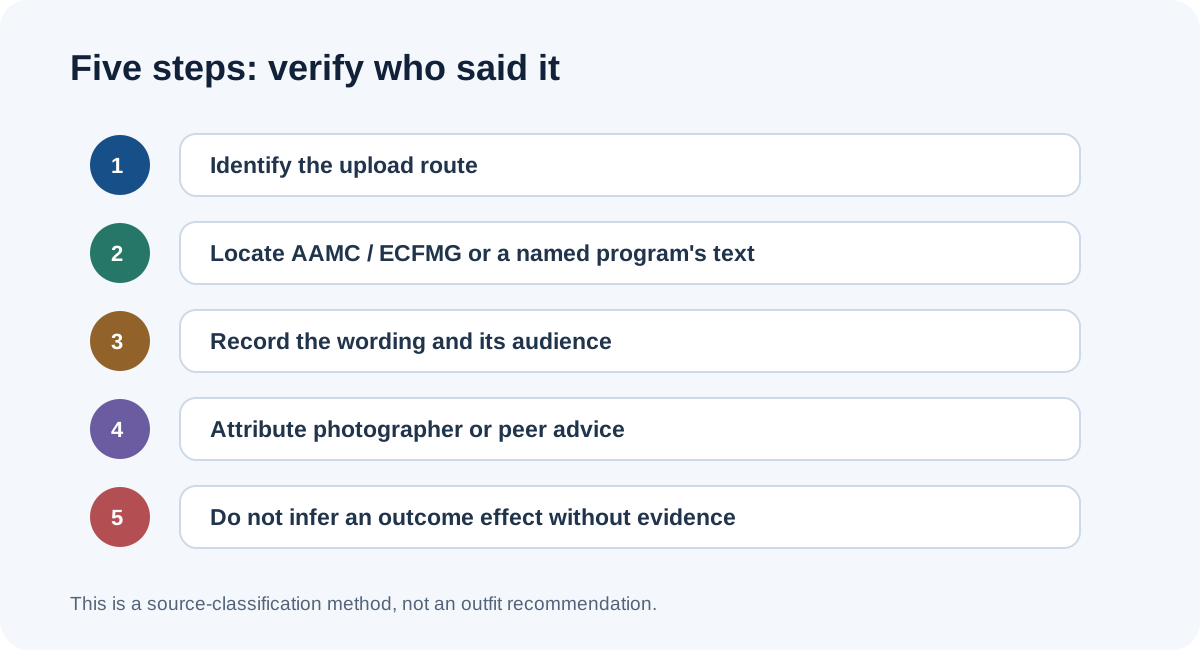
- Identify the route. Use the current photo page for direct MyERAS or the MyIntealth process described by ECFMG; do not blend their checklists.
- Locate the exact source. Find the requirement on AAMC/ECFMG’s public photo page, or find the program’s own written instruction. A service page, forum reply, or social post is a separate source type.
- Record the wording and scope. Note whether it names an image property, a specific garment, the relevant applicant route, or an individual program. Do not expand one program’s wording to all programs.
- Separate preference from rule. If the statement comes from a photographer or peer, preserve that attribution instead of labeling it an application requirement.
- Leave outcome claims unresolved without outcome evidence. Neither reviewed official photo page says that a suit, tie, or white coat changes interview selection. Do not infer such an effect from a clothing preference.
This check classifies the source of an attire statement; it does not choose an outfit, rate a person’s appearance, or predict a program’s decision. A recent public applicant discussion asked whether omitting a tie would look unprofessional. That question is useful evidence of uncertainty, but replies in the thread are personal opinions rather than an official dress code.
Common questions
Does ERAS require a white coat?
The reviewed public AAMC and ECFMG photo pages do not list a white coat as a requirement. This does not rule out an instruction from a particular program or a detail not shown on those pages.
Does the photo checklist require a suit or tie?
The reviewed checklists do not specify a suit or tie. A clothing recommendation from a photographer or another applicant should stay labeled as advice from that source.
Does “not specified” mean every outfit will be accepted?
No. It means only that the named public pages reviewed do not specify those garments. It cannot guarantee portal acceptance or settle a program-specific request.
Can attire affect interview selection?
The official photo pages reviewed do not state that a suit, tie, or white coat changes selection outcomes. The article does not infer an admissions effect from personal opinions or commercial advice.
Sources
- AAMC, Photo — direct MyERAS photo rules and direction to research programs individually.
- ECFMG / Intealth, ERAS Supporting Documents — Photograph — MyIntealth photo instructions.
- Public applicant discussion about wearing a tie in an ERAS photo — question signal only; not official policy.
Official wording was reviewed November 6, 2026. The applicant discussion reflects an individual question and opinions, not an official dress code or outcome evidence. No application portal or program account was accessed. This independent site is not affiliated with AAMC, ECFMG, Intealth, or ERAS Support Services.